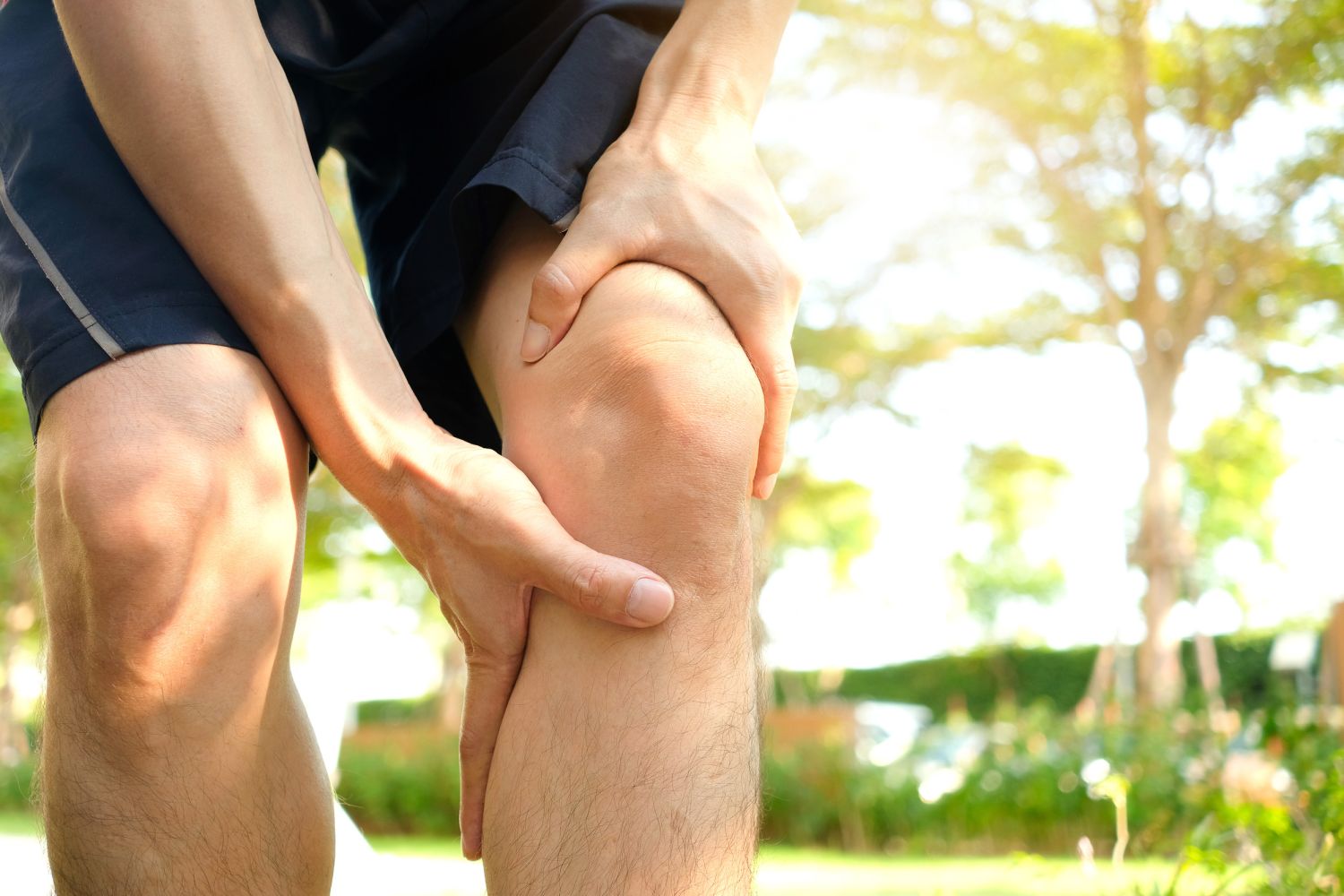
5 Potential Reasons Why It Hurts To Straighten Your Knee
Patient Education Articles | Nov 17, 2025
Knee pain is incredibly common and frustrating. One type of knee issue that can be more frustrating than most is when pain or an underlying injury makes it difficult or impossible to fully straighten your knee.
There are a few different structures and systems that must work together when you straighten your knee, and if any of them have been impacted by injury or degeneration, it can cause problems for your ability to fully extend your leg. Addressing the issue requires that you identify and target the true underlying cause. There are many. In today’s blog, we spotlight five underlying issues that could be causing problems for your ability to fully straighten your knee.
Why Your Knee Hurts When Straightening Your Leg
As we noted above, several different structures work in unison when you straighten your leg. Five specific areas commonly house the problem. Let’s take a closer look at each of these:
- The Quadriceps Muscle - Your quadriceps muscle and tendon contract to put your knee into extension. This muscle group is the driving force behind your ability to straighten your leg at the knee. Because of its proximity to the knee, it’s possible that an issue with your quadriceps is presenting as a problem with your knee. Muscle weakness and tightness are often to blame, as is a muscular imbalance between your quadriceps and your hamstrings on the backside of the leg. Tear of the quadriceps tendon can make it impossible to straighten your knee since the muscle is disconnected from the patella.
- The Patellar Tendon - Your patellar tendon connects your kneecap to your shinbone, and in doing so it plays a key role in transferring the force generated by your quadriceps muscle to your lower leg, in turn aiding in knee extension. Patellar tendon damage, rupture, or overuse can make it hard or impossible for patients to fully extend their leg.
- Cartilage or Loose Body in the Knee - Knee cartilage in the joint helps to prevent bone on bone contact and facilitate smooth movement when bending and extending your knee. Injury or age-related degeneration can cause cartilage to deteriorate, leading to painful contact between the bone ends that meet at the knee. If degeneration is moderate or severe, it could make it too painful to fully extend the knee. Sometimes a piece breaks off in an injury. A loose piece can get stuck in the front of the knee and cause a “locked knee.” This cannot be straightened without moving the loose piece out the way or removing it completely.
- Meniscus - Inside each knee are two crescent-shaped pieces of cartilage located on the inner and outer sides of the knee joint. They are called the menisci, and damage or tears in one of these pieces of cartilage is known as a meniscus injury. Meniscus injuries are more common during athletics where the person is pushing off the ground forcefully and oftentimes twisting or changing directions, as these forces can overload the menisci. This cartilage doesn’t get a healthy blood supply, so surgical repair is standard since it’s very unlikely that the meniscus will make a complete recovery on its own. A piece of the meniscus can also get stuck and lock the knee up from full motion. This often requires arthroscopic surgery with a tiny fiberoptic telescope.
- Ligament Damage - Finally, your inability to straighten your leg may be the result of a ligament injury. There are four main ligaments in the knee (the ACL, LCL, MCL, and PCL), but it’s the anterior cruciate ligament and the posterior cruciate ligament that provide stability to the knee joint by preventing excessive forward and backward movement of the shinbone relative to the thigh bone. Ligament damage or a torn ligament can lead to instability and difficulty straightening the leg and knee.
Some issues will require surgery, and you’ll want to connect with a knee specialist to pursue proactive treatment. Controlled exercise and physical therapy pair well with passive options like rest, ice, heat and anti-inflammatories. Your doctor can provide the best advice after a good history, a great exam, and some X-rays. Then they pinpoint your source of discomfort.
For more information about knee injuries that make straightening your knee difficult or impossible, or for help with a different knee issue, reach out to Dr. Reznik and his team, or pick up a copy of his latest publication, The Knee & Shoulder Handbook, available now on Amazon and at Barnes & Noble.
